
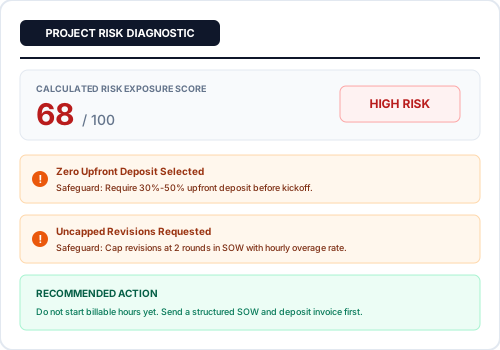
The Freelancer's Due Diligence Playbook: How to Audit Client Risk Before Signing Contracts
The most expensive mistake in freelancing is saying "yes" to a toxic client engagement without conducting commercial due diligence. Unpaid invoices, scope creep, and demoralizing endless revisions rarely occur by surprise—the warning signs were present during the initial sales conversation. Using our interactive freelance client red flags checklist, independent professionals evaluate contractual vulnerability across 14 weighted criteria, identifying exact legal safeguards before committing billable hours.
A freelancer project risk score checker before signing contract is a commercial decision-support audit tool that evaluates prospective client engagements across 14 high-risk parameters. Freelancers learning how to avoid bad clients as a freelancer use this diagnostic checklist to measure exposure to non-payment, unstated scope creep, design-by-committee, and premature intellectual property loss, generating a normalized 0–100 risk score with actionable contract mitigation steps.
The 14 Commercial Risk Factors Matrix
Our audit algorithm categorizes commercial vulnerability into four critical organizational dimensions:
| Risk Category | Critical Red Flag Evaluated | Commercial Impact |
|---|---|---|
| Financial Commitment | Client refuses upfront deposit; demands 100% on delivery | Extreme Non-Payment Risk: Freelancer bears 100% of upfront loss if project stalls |
| Scope Precision | Deliverables described vaguely without measurable acceptance criteria | Severe Scope Creep: Client claims unfinished status on subjective whims |
| Governance Hierarchy | Multiple stakeholders sending feedback without a designated decision-maker | Design-by-Committee: Contradictory revisions and months of wasted turnaround |
| Intellectual Property | Contract demands immediate copyright transfer prior to final payment | Zero Leverage: Client owns your work legally while withholding your balance |
| Revision Governance | No explicit cap on included review rounds in the initial quotation | Profit Margin Destruction: 10+ rounds of free visual experimentation |
How to Interpret Your Project Risk Score (0–100 Scale)
- Score 0 – 29 (Low Risk / Safe Contract): Standard, healthy commercial terms. The client respects upfront deposits, specifies a single project manager, caps revisions, and accepts standard milestone billing. Proceed with standard onboarding.
- Score 30 – 59 (Moderate Risk / Caution): Operational vulnerabilities exist. The client may be well-intentioned but disorganized. Mitigate flagged issues by issuing a detailed Scope of Work and enforcing a 50/25/25 payment schedule.
- Score 60 – 100 (High / Critical Exposure): Severe danger of non-payment or catastrophic scope creep. Do not begin work under current conditions. Present your required safeguards firmly—if the client refuses reasonable terms, decline the contract.
A high risk score does not always mean you must reject the client. Use the flagged points as a professional counter-offer: "To maintain our project schedule and ensure high-velocity delivery, our firm requires a 50% deposit to lock development resources and a single point of contact on your leadership team to sign off on milestones." Serious clients will respect your professionalism.