
Pricing is the single highest-leverage decision you make in your freelance career. Charge too little, and you suffer burnout on low-margin projects; quote incorrectly without buffers, and unexpected scope creep wipes out your profit.
In this guide, we break down the three primary pricing models used by independent consultants, creative professionals, and software developers: Hourly Billing, Fixed Milestone Pricing, and Value-Based Pricing. You'll learn exactly when to use each model and how to calculate a risk-adjusted quote that clients respect.
1. The Hourly Billing Paradox: Why Time Punishes Efficiency
Hourly billing is the most intuitive pricing model for beginners: Hours Worked × Hourly Rate = Invoiced Total. If you work 20 hours at $75/hr, you bill $1,500.
However, hourly billing creates an inherent conflict of interest between you and your client. As you become more experienced, skilled, and fast, under strict hourly billing, your reward for mastery is a 70% pay cut. Clients scrutinize timesheets, turning your relationship into an accounting audit.
2. Fixed Milestone Pricing: The Industry Standard
For 80% of client engagements (branding packages, custom website builds, SaaS MVP development, marketing campaigns), Fixed Milestone Pricing is the most practical and profitable structure.
Clients love fixed pricing because it eliminates budget uncertainty. They know upfront that the project will cost exactly $5,000. For you, it decouples income from time: if you finish early with high quality, your effective hourly rate increases.
The 20% Contingency Buffer Formula
The biggest danger of fixed pricing is misestimating project duration. To protect your margins, always apply the Freelance Project Pricing Formula:
Project Total = (Estimated Realistic Hours × Desired Base Hourly Rate) × 1.20 (Scope Buffer) + Fixed Expenses
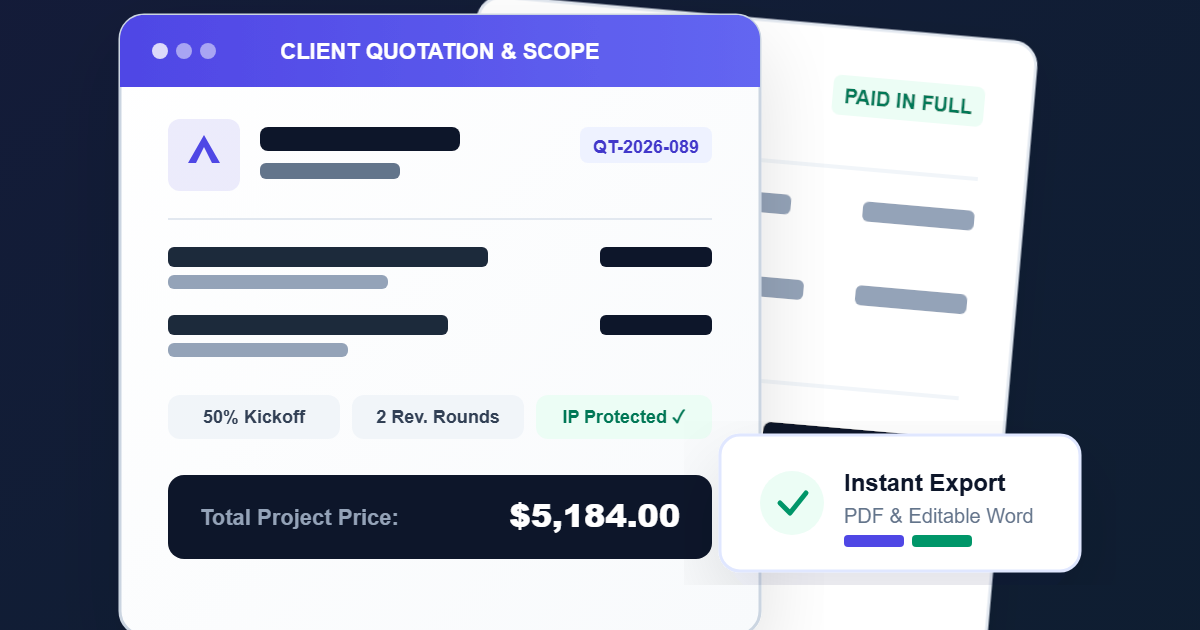
Use our free Freelancer Quotation Generator to calculate this automatically with line-item milestones.
3. Value-Based Pricing: Charging for Commercial ROI
Value-based pricing means charging based on the economic value you create for the client's business, rather than the hours it takes you to perform the work.
If redesigning an e-commerce checkout flow increases revenue by $150,000 annually, charging $15,000 is an extraordinary 10x ROI for the client, regardless of whether it took you 30 hours or 100 hours.